By Thomas Jilk
Hauben says experiences at UW–Madison enabled her to creatively solve data-centric problems.

Jaclyn Hauben didn’t go looking for an actuarial AI competition. But this spring, Hauben, a double major in Computer Sciences and Data Science, was scrolling through a newsletter from an advisor when a call for the Pacific Life AI Actuary Challenge caught her eye. The challenge asks participants to combine artificial intelligence (AI) and data skills to solve a real actuarial challenge. At that point, “I didn’t know the stakes of applying and getting accepted into this,” Hauben said. But it seemed like a tangible way to practice some of the skills from her courses.
A few weeks later, she found herself navigating a selective interview process, analyzing hundreds of thousands of medical records from wearable devices, presenting to the CEO, and ultimately helping her three-person team emerge victorious in the North America-wide competition.
Making sense of wearable data
This year, the competition’s prompt asked groups to determine whether data from wearable devices (think Fitbits and Apple Watches) could meaningfully improve Pacific Life’s predictive models for mortality risk assessment. “We were given hundreds of thousands of lines of data,” Hauben said, describing a massive collection of dummy medical records that included both wearable users and non-users.
Hauben’s team took a more applied path than other teams in the competition. “We wanted to figure out whether the data could actually be included in Pacific Life’s pricing models,” she said. Generative AI played a role; Hauben and her teammates used it to scan column headings, identify relevant variables, and surface potential modeling approaches.
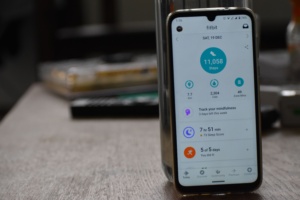
Their bottom-line finding: Despite the promise of wearable technologies, the data they were given could not currently improve mortality risk prediction for Pacific Life. That’s because two major underlying biases were at play in the data, Hauben explained. First, people with serious diagnoses were also the most consistent wearable users, and second, people who could afford wearables were generally wealthier and healthier in the first place. These biases skewed the data and compromised its value to the company’s models — a case study in the importance of random sampling.
Just before their final-round presentation, Hauben recalled, her team was met with a surprise. “They said, ‘Please welcome the CEO of Pacific Life,’” she recalled. “I had no warning.” Nonetheless, her team delivered a clear, company-focused presentation that ultimately earned them first place. The win came with a $1,000 prize, an internship interview, and, “They want to fly me to their headquarters in California,” Hauben added.
Prepared in Madison
Hauben’s experiences in Madison gave her a strong foundation to address the competition’s prompt. She said STAT 340, a data modeling course with Teaching Faculty Bi Cheng Wu, provided the techniques she needed to work efficiently in R and handle the scale of the dataset. In addition, she credited UW–Madison’s fast-paced hackathons, especially MadHacks, with preparing her for the intensity of the competition. “Having that similar layout was very helpful,” she said. The teamwork, time pressure, and rapid problem-solving mirrored the environment she encountered at Pacific Life.
Though she’s interning at the insurance company Sentry this summer, Hauben sees her long-term future in cloud computing or Development and Operations (DevOps). Two years ago, she chose Wisconsin for its Computer Sciences department’s strong reputation and added Data Science because it “felt highly applicable to so many things,” especially in the age of AI. Students like Hauben represent the next wave of computing and data professionals, trained at UW–Madison to harness powerful new technologies skillfully and thoughtfully.
Learn more about the Computer Sciences major or the Data Science major.