
On November 13, the School of Computer, Data & Information Sciences hosted its inaugural World Usability Day celebration, where the global movement for accessibility and human-centered design turned interactive at Morgridge Hall.
Throughout the day, students, staff, faculty, and industry professionals explored how technology can better serve its users through human–centered design. Participants tested real software under development at Epic, the UW–Madison Center for User Experience, and UW Credit Union, joined an expert panel featuring leaders from UW Health and Delve Product Design, and interacted with exhibits demonstrating both the barriers to, and remedies for, accessibility.
Leah Ujda, MA’07, UX Professor of Practice and organizer of the event, reflected: “I was thrilled to see so many people come to Morgridge Hall to explore the fundamentals of human-centered, usable design. When we put humans at the center of our design and development processes, we can create solutions that genuinely meet needs and make a meaningful difference in people’s lives.”
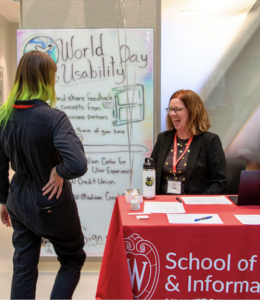
MyChart usability testing
Epic’s user experience team invited participants to navigate MyChart (used by over 195 million patients) and provide live feedback on a prototype of a new feature. “This is valuable to us,” said Annabelle Mosier, a member of Epic’s user experience team. “Any way we can get diverse patient feedback [helps]. People from all backgrounds use MyChart, so working with students is a great way to gather different perspectives.”
A first-year MA student in Library & Information Studies reflected on the experience: “I’ve taken classes around exactly what this is. I feel very strongly about things being accessible. I’ve worked on class projects where I’ve had to design things and then have people give feedback, but I’ve never been on this end before. It’s fun.”
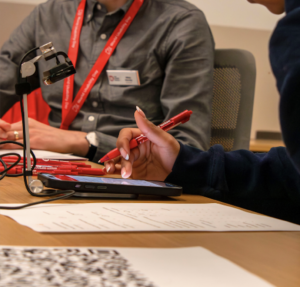
Testing financial design with UW Credit Union
Nearby, Mikko Utevsky ’16 (Lead UX Researcher, UW Credit Union) led a usability study for UW Credit Union’s mobile app prototype. “UW students, faculty, and staff have always been the core of our membership,” he said, “and it’s exciting for us to connect with people on campus directly in spaces like this and hear their feedback face-to-face.”
Senior Batool Nafid, a finance major and computer sciences minor, learned about the events through her coursework, Computer Sciences 570 (Introduction to Human-Computer Interaction) and Computer Sciences 571 (Building User Interfaces). She enjoyed exploring the prototype, observing, “I love when I see my credit score, like, which color am I?”

Experiencing accessibility barriers, fostering empathy
Attendees also explored “accessibility empathy stations” – interactive exhibits designed to help participants understand what it’s like to use digital products that were not built with accessibility in mind. Laura Grady ’18 (Capstone Certificate in User Experience Design), Leah Bowers MA’24, and Al Nemec (Digital Accessibility Program Manager, UW–Madison Center for User Experience) led this activity. To grow empathy and encourage reflection on design and accessibility, participants were guided through prompts that asked them if adjusting colors or patterns led to improvements in clarity, and whether (if they listened to the screen reader) the page order made sense.
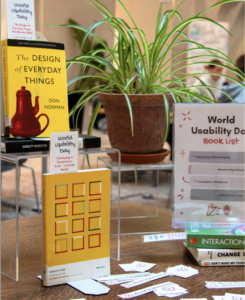
Reaching across campus
From prototypes to screen readers, the day offered a rare opportunity to see design principles tested in real time — and to connect with colleagues from across campus. For David Berg (Business Intelligence Developer, School of Medicine and Public Health), usability is paramount: “We get a lot of data, [and] people need to have access to that data. Usability-wise, a really good way to use that is: can you make this [data] understandable? Crucially, is it understandable to make decisions based off?”
That perspective was shared throughout the event, reflected in conversations about how usability shapes decisions across campus. “I love it,” Nafid added. “And I love the new building — it just invites stuff like this.”
Thank you to our event sponsors and in-kind partners: UW Credit Union, UW Health, UW–Madison iSchool, Delve, Epic, UW-Madison Center for User Experience, and UW-Madison Master of Science in Design + Innovation.