A team of UW–Madison computer scientists is pioneering a new approach to health monitoring: using radar to measure breathing and heart rate without physical contact. Their multiview sensing system could pave the way for safer, more comfortable patient care in settings ranging from neonatal units to in-home recovery.
When you think about monitoring heart and breathing rates, you likely picture a wearable device — a wristband, chest strap, or sticky patch connected to a maze of wires. But what if monitoring your breathing or heart rate didn’t require contact at all?
For UW–Madison Computer Sciences Professor Suman Banerjee, that future is a near possibility. In collaboration with researchers at the Georgia Institute of Technology and with support from the National Science Foundation, his team is developing a system that uses radar to monitor vital signs without touching patients, even the smallest ones, at all. Their first-of-its-kind contactless vital-sign sensing system (called MEDUSA) lays the foundation for a feasible new way to support healthcare settings from home care to neonatal intensive care units (NICUs), enabling free movement for patients.
Why contactless sensing matters
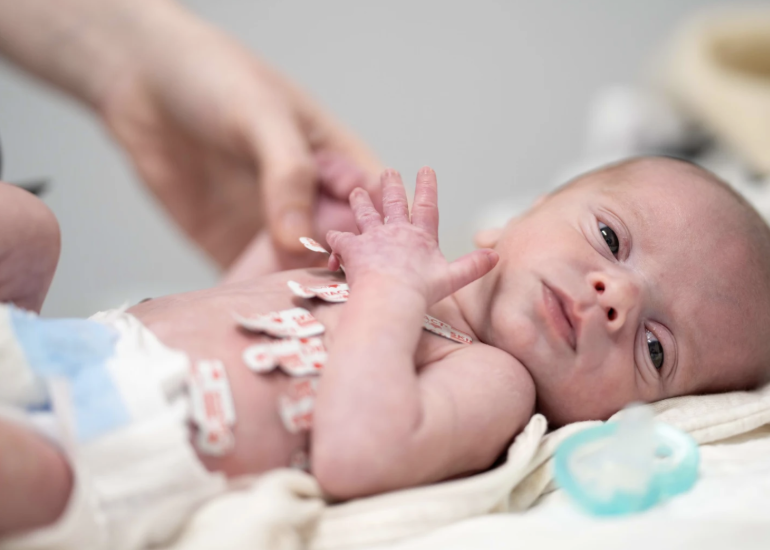
Banerjee has long been interested in ways contactless technology can support healthcare. He points out that even the best-designed wearables and clinical monitors bring challenges: “In the NICU, the very devices that monitor fragile infants can also cause skin abrasions, introduce infection risks, or become tangled,” he notes. For adults, wearables can be uncomfortable or even inaccurate when poorly fitted.
Contactless sensing offers an appealing alternative. Because radar waves can detect small chest movements, they can infer vital signs such as breathing and heart rate without attaching anything to the body.
Making contactless sensing work in the real world
Existing radar systems struggle to detect vital signs outside of controlled lab settings because people naturally move around, turn away from the sensor, and change their posture throughout the day.
MEDUSA overcomes this by placing several radar units throughout a room, creating a multiview system that detects vital signs even when one or more sensors lose line of sight. Custom hardware combined with tightly integrated software separates vital signs from other movements. The result is a system that works in real-life patient settings.
From emergency response to patient care
Banerjee’s interest in using wireless technologies to help people isn’t new. In 2021, his team, including Assistant Professor of Computer Sciences Yuhang Zhao and Associate Professor of Design Studies Kevin Ponto, received a National Institute of Standards and Technology award from the U.S. Department of Commerce to develop augmented-reality headsets that help first responders navigate challenging indoor environments safely.
MEDUSA builds on this foundation. The long-term goal is to make radar hardware more compact for use in real-world settings, whether in augmented-reality headsets or in fixed locations like patient rooms.
“We’ve shown that this distributed approach works,” Banerjee says. “Now we want to make it feasible for environments like the NICU.”
A path toward NICU deployment
For NICU settings, a compact, contactless radar system could be transformative. Continuous monitoring without wires or adhesives would reduce risks for medically fragile infants. It could also reduce staff burden by giving clinicians a clearer view of an infant’s condition without disturbing them.
The team is now exploring new funding opportunities to take touchless radar sensing from a research prototype to a system that can support patients. And perhaps a more fundamental shift in how we approach health monitoring is on the horizon: from the devices we wear to the environments around us.
Banerjee and team are seeking funding to refine the technology, explore applications, and partner with federal agencies, nonprofits, industry collaborators, and investors toward commercialization. Learn more about the impact of UW–Madison’s federally funded research and how you can help protect it.