Computer Sciences and Psychology alum Thomas Triplett builds the behind-the-scenes tools that keep Alaska Airlines flying.
Some of the most impactful software is never seen by customers. As a senior software engineer at Alaska Airlines, Thomas Triplett ’20, builds internal platforms that help engineering teams work more efficiently — improving reliability and reducing complexity for systems that operate at scale. Before joining Alaska Airlines in early 2025, Triplett’s experiences at UW–Madison sparked an interest in how software can support the people who use it. That curiosity has shaped a career focused on building systems that help others do their best work.
From UW–Madison to real-world systems
While earning a Bachelor of Science with a double major in Computer Sciences and Psychology at the University of Wisconsin–Madison, Triplett pursued rigorous coursework in computer graphics, data management, artificial intelligence (AI), programming, and algorithms.
At the same time, he gained hands-on experience outside the classroom, working part-time as a web developer for the university’s Division of Continuing Studies, whose mission is to support lifelong learning. There, classroom concepts turned into practical problem-solving as he helped develop instructional websites and tools. “It was the first time I really saw how what I was learning in my coursework could translate directly into something people relied on,” he reflected.
Scaling impact across industries
After graduating in 2020, Triplett joined State Farm as a software developer, a role that demanded both technical depth and adaptability. There, he developed behind-the-scenes software that empowers developers and quietly powers the infrastructure behind everyday services. After just a year, he was promoted to software engineer, and in 2023, to lead software engineer. He was awarded six State Farm “Good Act” awards as well as a “Good Impact” award during his time there — internal honors that recognize employees whose work delivers measurable value at scale, from improving systems to driving cost savings and efficiency.

In one project, he optimized big-data workflows to generate reports for millions of insurance records. In another, he created a developer application programming interface (API) that has saved hundreds of thousands of dollars in external vendor costs while improving internal efficiency. “Working on such a diverse array of projects has helped me grow into the role I’m in today,” says Triplett.
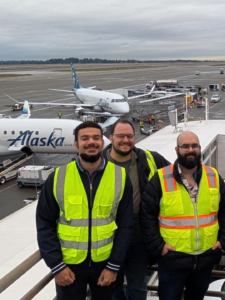
Today, Triplett is a senior software engineer for Alaska Airlines. Rather than building customer-facing products, he focuses on internal platforms that developers rely on behind the scenes. By designing tools that streamline application management and surface critical information, Triplett helps developers work more efficiently and with greater confidence.
“Seeing the impact my work has on other developers is fulfilling and leaves me optimistic about what lies ahead,” he said. And as society confronts the rapidly changing technology landscape brought on by artificial intelligence, Triplett believes engineers should view AI as a tool rather than a replacement for understanding:
AI can be a powerful developer tool when you know what you’re doing, but you shouldn’t let it think for you. If you don’t understand how it came to a certain solution, ask follow-up questions to clarify any logic or assumptions it may have used. The impact of AI is unavoidable, but you can make it work for you rather than against you.
This is the third installment in a series highlighting the career paths of School of Computer, Data & Information Sciences alumni. Read part one featuring Christian Willis MS’25 at Walmart Global Tech, and part two featuring Sreya Sarathy ’25 at Northwestern Mutual.