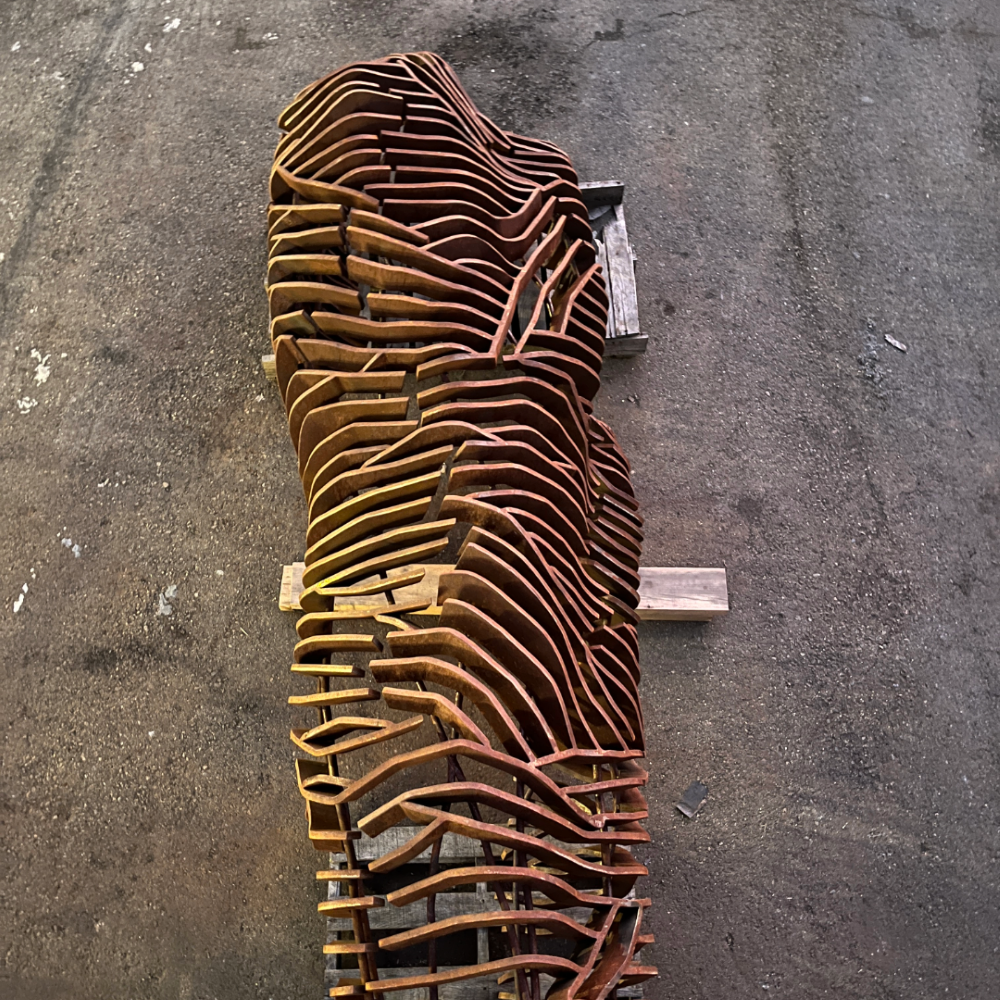
What is the background story that inspired you to create this piece?
Ghost Forest developed out of my thinking about how people interact with their local environment, its embedded histories, and how its physical, social and political dimensions change over time. The forms reference the bark structures of Bur Oak and Black Locust trees that are easily identifiable all over the UW Madison campus and are emblematic of both the native prairie landscape and the forested areas that have become more common and also have specific links to the development of modern ecological thought at UW Madison.
In response to these cues, I began thinking about landscape not as a vista but a set of structural conditions that make a place the way that it is and that over time are manipulated by a kind of dance of local, regional and global actors. Thinking about how to represent these ideas got me into some very thorny terrain about where these concepts begin and end and how to represent them. This piece is as much derived from specific iconography as it is about a struggle to represent ideas that resist containment.
Formally, the sculptures are intended to be somewhat elusive. From a distance they appear transparent; physically present but appearing as a shimmering outline that changes as one moves around the artwork. As viewers move closer to the artwork, the forms become more solid as the flat faces of the bars begin to fill one’s field of view rewarding closer examination and interaction on a personal scale. This formal metaphor felt apt to me in thinking about how to represent states of nature that often reveal themselves on close inspection but disappear into a sea of complexity as one steps away. My hope is that, like many things in life, it is worth giving Ghost Forest a closer look.
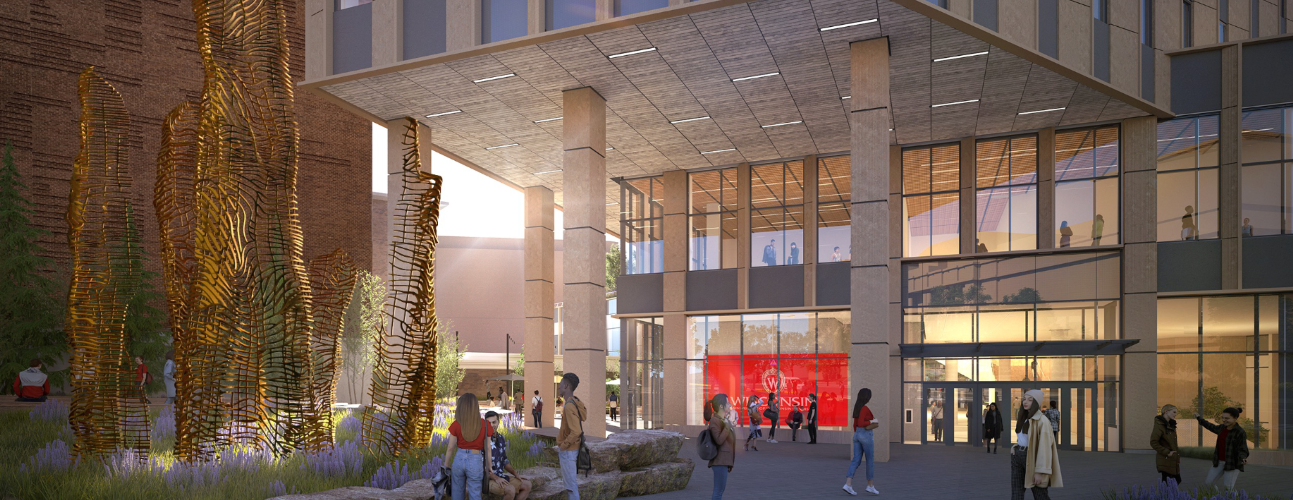
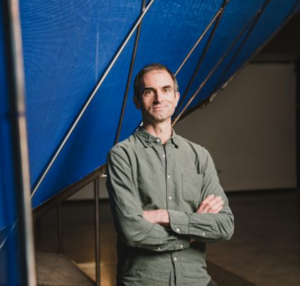 Created by Seattle-based sculpture artist, Clayton Binkley, Ghost Forest developed out of his thinking about how people interact with their local environment, its embedded histories, and how its physical, social and political dimensions change over time. The forms reference the bark structures of Bur Oak and Black Locust trees that are easily identifiable all over the UW—Madison campus and are emblematic of both the native prairie landscape and the more recent impression of “nature” in the area as well as having specific links to the development of modern ecological thought at UW Madison.